
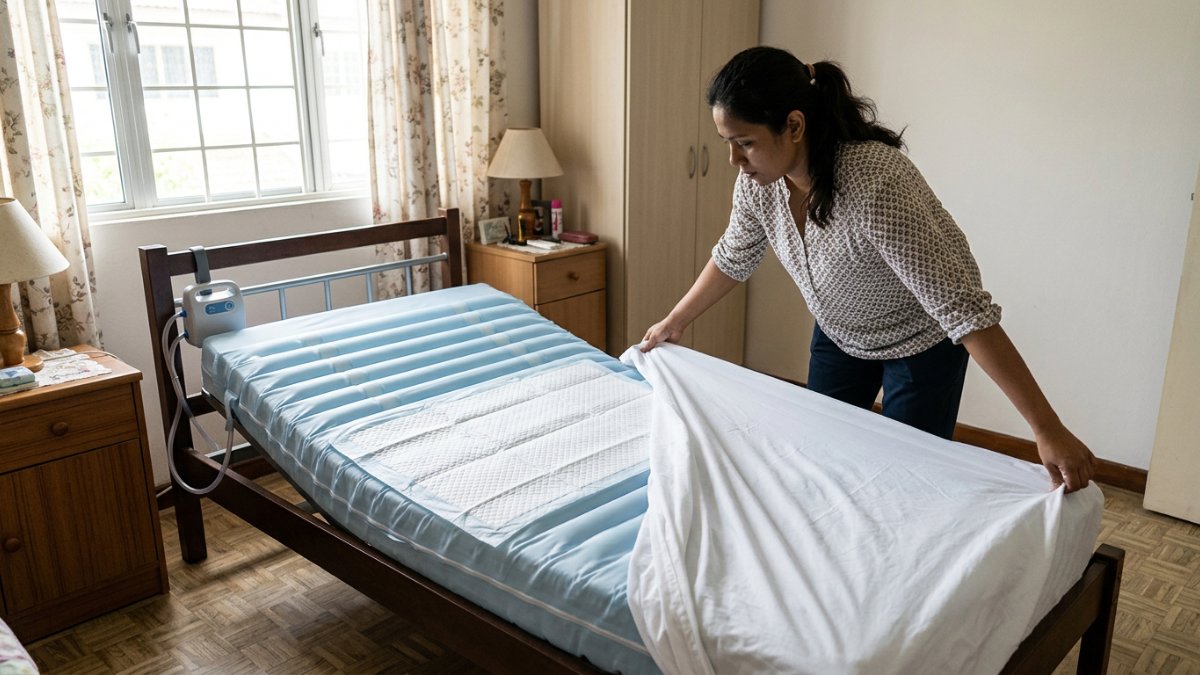
An anti bedsore mattress is designed to spread pressure by filling and emptying its air cells in turn. What you put on top of it can help that work or quietly block it. A thick quilt, a folded towel or three underpads stacked together can all soak up the movement before it reaches the body.
At Neolee Rehab Supply, families often ask us how to make up the bed once the mattress arrives. This guide covers the sheets, pads and layers we suggest for the air mattresses in our anti bedsore range. It is general equipment information, not medical advice, so follow the pressure-care plan from your nurse or doctor.
Why the top layer matters on an air mattress
An alternating pressure mattress works in cycles. Some cells fill while others go soft, so the same patch of skin is not pressed for too long. On our Anti Bedsore Tube Mattress, one full cycle takes 12 minutes.
Every layer between the cells and the skin softens that change. One thin sheet barely affects it. Several thick layers can turn a moving surface into a flat, still one.
So the rule of thumb is simple. Keep what is on the mattress thin, smooth and as few as possible.
Sheets that let the cells do their work
A plain cotton fitted sheet is usually the best choice. It is thin, it breathes and it tucks in without pulling the mattress tight. Avoid sheets made for thick spring mattresses, because the deep pockets leave loose folds.
Make the sheet loose enough to move with the cells. If you stretch it very tight, it can act like a drum skin over the top. Then the cells push against the sheet instead of the body.
Smoothness matters as much as thickness. A crease under the hip or heel is a small ridge pressing into the same spot all night. After you make the bed, run your hand flat over the area where the person lies.
Some carers like a flat sheet instead of a fitted one. That works too, as long as you tuck it in at the sides and it stays flat when the person turns.
Using underpads without building up layers
An underpad is a flat absorbent pad placed under the hips to catch leaks. It saves you changing the whole bed after every accident. Our Anti Bedsore Bubble Mattress has a waterproof PVC surface, but an underpad still keeps the sheet dry and the person more comfortable.
Use one underpad at a time, placed only where it is needed. The Activ Underpads XL are 90 cm x 60 cm, which covers the area from the lower back to the thighs on most adults. There is no need to cover the whole bed.
It is tempting to stack two or three pads “just in case”. Each one adds thickness, heat and another edge that can wrinkle. If leaks keep getting past one pad, it is better to review the diaper or pants size than to add layers.
Lay the pad flat with no folds. Smooth it out each time the person is turned.
Layers to keep off the mattress
Some well-meant extras work against an air mattress. Here are the common ones we see:
- A foam topper or egg-crate pad on top of the air cells
- A thick quilt or comforter folded under the person for “softness”
- Several towels to absorb sweat
- A plastic sheet or bin bag to protect the mattress
- Pillows or rolled blankets wedged along the length of the body
A topper or quilt blocks the alternating movement. Plastic traps heat and sweat against the skin. Wedged pillows press into one spot for hours.
If the person feels cold, put the blanket on top of them, not under them. If you need positioning pillows, ask the care team where to place them and for how long.
A simple bed-making routine for carers
Making the bed with someone lying in it is easier with a set order. This is one way to do it with two people, in this order:
- Check the pump is running and the mattress feels evenly filled.
- Roll the person gently to one side, facing the carer who supports them.
- Roll the old sheet and pad towards the middle of the bed.
- Lay the clean sheet on the empty half and tuck it in. Place a fresh underpad at hip level.
- Roll the person back over the rolls onto the clean side.
- Remove the old bedding from the other side and pull the clean sheet through.
- Smooth out every fold and check the heels and hips.
If the person cannot be turned safely by one carer, wait for a second pair of hands. Rushing a turn is how sheets end up creased and skin gets dragged.
Signs the bedding needs to change
Change the sheet and underpad as soon as they are wet or soiled. Damp bedding softens the skin and makes it easier to damage. Also change them if they are bunched, stained with cream or have crumbs on them.
During each change, look at the skin over the hips, lower back, shoulder blades and heels. Redness that does not fade after the pressure is off is a sign to tell the nurse or doctor. A mattress supports pressure care, but it does not replace turning; our article on whether an anti bedsore mattress can replace repositioning explains why.
Keep a short note of when you changed the bed and anything you noticed, such as a damp patch or a new red area. That record helps the care team see a pattern early.
Frequently Asked Questions
1. Can I use a normal fitted sheet on an anti bedsore mattress?
Yes. A thin cotton fitted sheet that tucks in loosely is usually fine. Avoid deep-pocket sheets that leave loose folds.
2. How many underpads should be on the bed at once?
One, placed under the hips. Stacking several pads adds thickness and wrinkles, so check the diaper or pants fit if leaks keep happening.
3. Can I put a foam topper or blanket under the patient for comfort?
We advise against it. Extra layers between the person and the air cells can block the alternating pressure, so put blankets on top of the person instead.
4. How often should the bedding be changed?
Change it whenever it is wet, soiled or creased. Otherwise follow your normal household routine and the care team’s advice.
5. What should I do if the skin looks red after changing the bedding?
Note where the redness is and check it again after the pressure is off. If it does not fade, tell the nurse or doctor before the next turn.

