
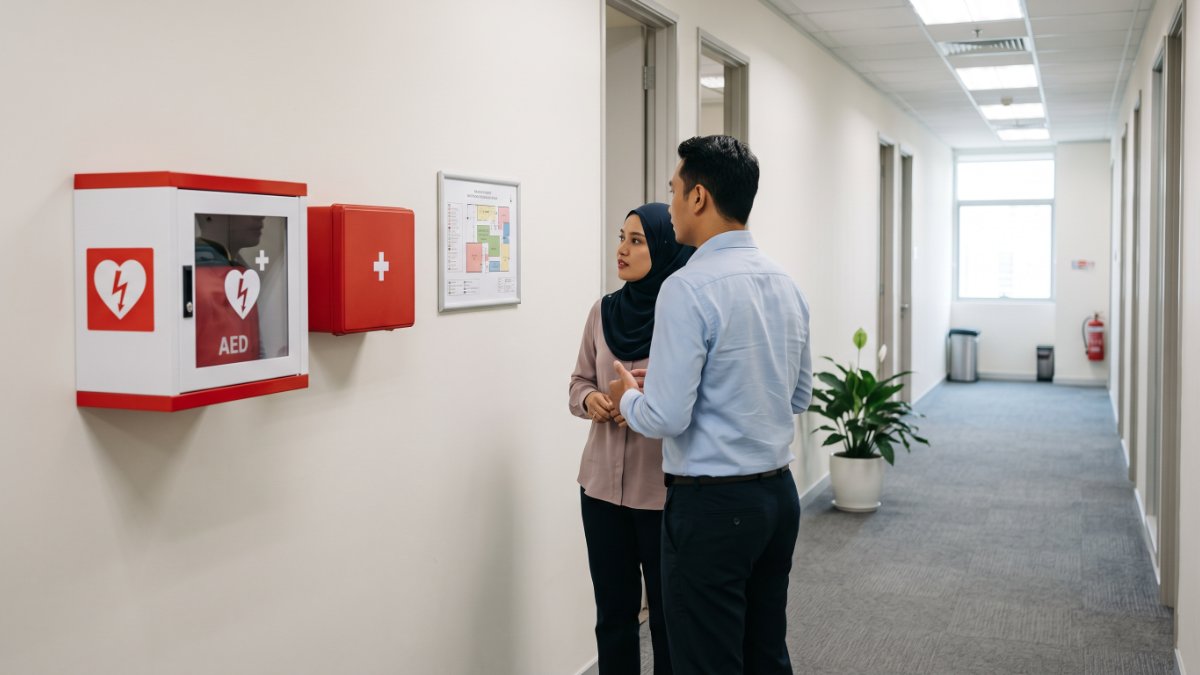
Emergency and first aid equipment only helps if people can find it, reach it and use it within minutes. An AED in a locked office or a first aid kit nobody has opened gives a false sense of safety. At Neolee Rehab Supply, we help offices, schools, gyms and care centres plan the people and the routine around the equipment, not just the purchase.
An AED, or automated external defibrillator, is a portable device that checks the heart’s rhythm. It can deliver a shock when the heart has stopped beating normally.
This checklist covers the response plan, where to keep equipment, training and practice. It is general guidance only. Follow your local rules, your organisation’s safety policy and recognised first aid training.
Write a Simple Response Plan First
Equipment comes second. The first step is a short written plan that everyone can follow under stress.
A good plan answers these questions in plain words:
- Who calls 999, and what address and entrance do they give?
- Who fetches the AED and first aid kit?
- Who starts CPR and who takes over when they tire?
- Who meets the ambulance at the gate or lobby?
CPR stands for cardiopulmonary resuscitation. It means chest compressions, and sometimes rescue breaths, that keep blood moving until help arrives. An AED supports CPR. It never replaces calling for emergency help.
Print the plan on one page. Put it beside the AED, at reception and in staff areas.
Choose Where the AED Lives
Location matters as much as the device. In a cardiac arrest, every minute without help counts. The AED should be quick to reach from every part of your site.
Pick a spot that is:
- Central, visible and clearly signed.
- Free to reach during opening hours, not behind a locked door.
- Away from direct sun, heavy dust and rain.
- Known to every staff member, including part-timers and cleaners.
You can compare the units and supplies in our Emergency & First Aid range. One example is the Nihon Kohden Cardiolife AED-3100 Semi Automatic Defibrillator, which gives voice instructions. Semi-automatic means the device tells you when a shock is advised, and a person presses the button to deliver it.
For a large building, one AED may not be enough. Walk from the furthest corner to the AED and back, and time it. If the round trip feels long, ask your safety adviser whether a second unit makes sense.
Build a First Aid Kit That Fits Your Site
There is no single perfect first aid kit. A kitchen, a warehouse and a kindergarten face different risks. Start with the injuries that are most likely where you are, such as cuts, burns, sprains or falls.
Keep the kit in a clearly marked box near the people most at risk. Add a contents list inside the lid. That list makes it easy to see what has been used.
Store gloves with both the kit and the AED. In an emergency, nobody should have to search for them.
Name one person to restock the kit, and a backup for when they are away. When everyone is responsible, nobody refills the plasters.
Keep Live and Training Equipment Apart
This is one of the most important rules on any site. A training AED looks very like a real one, but it cannot deliver a shock. Using a trainer in a real emergency would waste precious time.
Our Prestan Professional AED Trainer Plus is made for practice and training only. It is not a working defibrillator. You can see other practice units in our AED Trainers section.
Store training equipment in a separate room or cupboard, away from the live AED. Label it clearly as training equipment. Never mount a trainer in the place where staff expect to find the real device.
Check the AED Before You Need It
An AED checks itself, but someone still needs to look at it. Agree who does this and how often, based on the maker’s instructions.
A quick visual check usually covers:
- The status indicator shows the device is ready.
- Pads are sealed and within their use-by date.
- The battery is in place and within its date.
- Gloves, a razor and a small towel are stored with it, if your plan includes them.
Keep spare pads that match your model. For the AED-3100, the matching pads are the Nihon Kohden Disposable Defibrillator Pads for Adult/Child (P-740K). Pads from another brand may not fit or work.
Record each check on a simple sheet kept with the device. Note the date, who checked it and anything that needs action.
Train People, Then Practise Together
A course on paper is not enough. People forget steps they have not used for months, especially under pressure.
Ask your team to attend recognised first aid, CPR and AED training. Then run short practice sessions on your own site, using training equipment. Practise the full plan: raising the alarm, fetching the AED, starting CPR and guiding the ambulance crew in.
After each practice, ask what slowed the team down. Maybe the AED sign was hard to see, or nobody knew the gate code. Fix those details before the next session.
Cover nights, weekends and visitors
Emergencies do not keep office hours. Check that the plan still works on night shifts, weekends and public holidays, when fewer trained people are around. Name a responder for each shift.
Make sure security guards and cleaners know where the AED is and how to call for help. Clear signs also help visitors and contractors who do not know your building.
After Any Real Use
If the AED or first aid kit is used, the response does not end when the ambulance leaves. Replace any used pads and supplies straight away. Check the AED as the maker instructs before you return it to its place.
Write down what happened and how long each step took. Share what you learned with the team, then update the plan.
Frequently Asked Questions
1. Does an AED replace CPR?
No. An AED works together with CPR. Call 999 first, start CPR and use the AED as soon as it arrives.
2. Can a training AED be used in a real emergency?
No. A training AED cannot deliver a shock. Store trainers away from the live AED and label them clearly.
3. Where is the best place to keep an AED at work?
Keep it in a central, visible and signed spot that stays open to reach when people are on site. Everyone should know where it is.
4. How often should someone check our AED?
Follow the maker’s instructions. Many sites do a quick visual check of the status light, pads and battery dates on a regular schedule.
5. Can I use any brand of pads with our AED?
Use only pads made for your AED model. Pads from another brand may not connect or work properly.

