
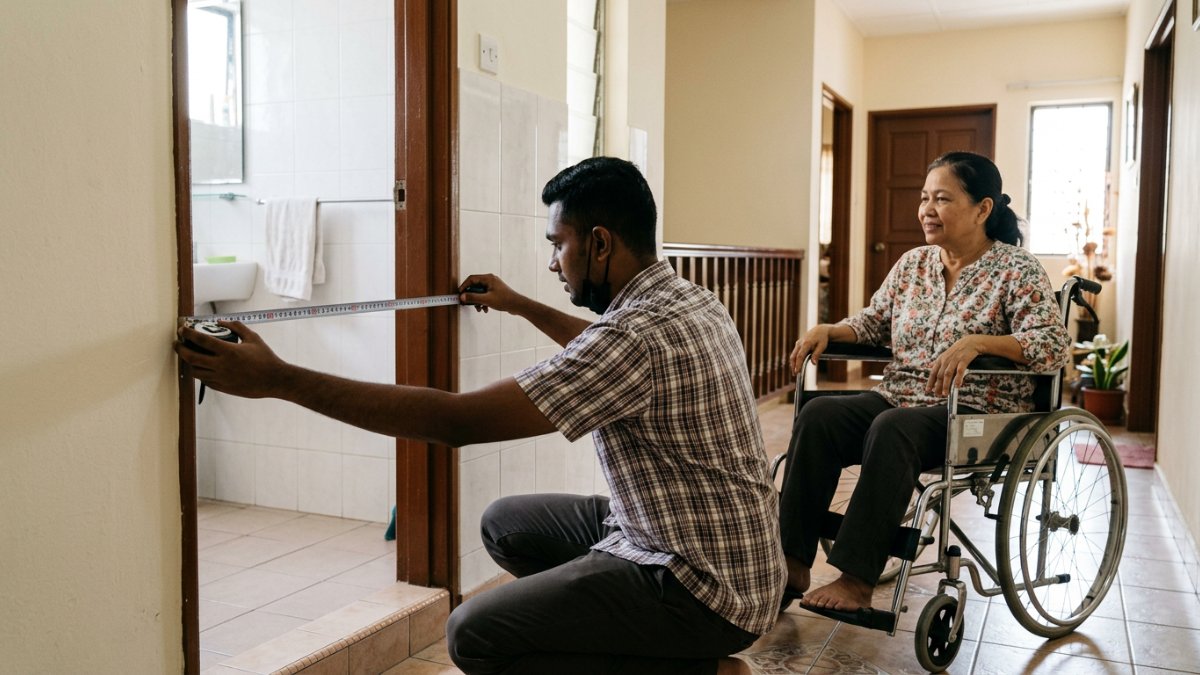
A wheelchair will usually fit through a door if the clear opening is a few centimetres wider than the chair on each side. The only reliable way to know is to measure your doorways and the chair before you buy. Then compare the numbers with the overall width of the wheelchairs you are considering.
At Neolee Rehab Supply, we ask families for these measurements before recommending a chair. Once you have your numbers, our Wheelchairs page makes it easier to shortlist chairs that suit your home.
This guide walks you through each tape-measure check, room by room. You will need a metal tape, a pen and a sheet of paper. Ask a family member to help hold the tape, since two people measure more accurately than one.
Measuring doorways the right way
Many people measure the door leaf, which is the door panel itself. This gives the wrong number. What matters is the clear opening, or the space a chair can actually roll through.
Open the door as far as it goes. Then measure from the face of the open door to the door stop on the other side. The door stop is the thin strip of wood the door closes against.
- Measure at floor level, at knee height and at waist height.
- Write down the smallest of the three numbers.
- Note any raised sill or threshold, and how tall it is.
- Repeat for every door the user will pass through daily.
A bathroom door is often the narrowest in a Malaysian home. For example, a bedroom door might give 78cm of clear space, while the bathroom gives only 65cm. Check the toilet and shower area first, because that is where a tight fit causes the most trouble.
Corridors, corners and turning space
A door that is wide enough can still be hard to use. The chair has to line up straight before it goes through. If the door opens off a narrow corridor, there may be no room to make that turn.
Turning space is the floor area a chair needs to change direction. Stand in the corridor and measure its width at the point where the user must turn. Then measure the distance from the corridor wall to the door frame.
A quick test helps here. Put a dining chair where the wheelchair would sit and try to angle it towards the door. If you keep hitting the wall, the user will likely struggle too.
Also look at the floor. Rugs, shoe racks and thick mats can steal space and catch the front wheels. In flats and terrace houses, the kitchen and back door area are common pinch points.
Reading the width of wheelchairs
Product pages often list several measurements. The seat width tells you how wide the sitting area is. The overall width is the full chair from the outside of one wheel to the outside of the other. For a door, the overall width is the number you need.
Overall width is always larger than seat width, usually by a good margin, because the wheels, push-rims and frame all add to it.
For instance, our Deluxe Compact Wheelchair (18″ Seat, 20″ Tyre) has a 46cm seat width. Once you add the wheels, the chair itself is wider than that. Ask us for the overall open width of any model before you decide.
It also helps to check how the chair handles transfers in a small room. The Deluxe Compact model has flip-up armrests and legrests, which can make moving onto a bed or toilet easier where space is short. Its backrest also folds, so the chair takes up less room when it is not in use.
The user’s hands also need room. Someone who pushes the wheels alone holds the push-rims, which sit outside the frame. Allow extra clearance so their knuckles do not scrape the door frame.
Compare your smallest doorway number with the overall open width. If the gap is very tight, consider a narrower chair or a change to the door. A therapist can help you balance width against comfort and support.
Small changes that make room
You may not need building work to gain space. A few simple changes can add several centimetres to a tight doorway.
- Swing-clear hinges let the door swing fully out of the opening.
- Taking a door off its hinges removes the panel from the space.
- A curtain can replace a bathroom door where privacy still matters.
- A small threshold ramp can ease a raised sill.
- Moving furniture can widen the approach to the doorway.
For example, removing a door may gain you the thickness of the door panel. Measure again after each change to see what you have gained. Ask a contractor before you cut or move any door frame, since some walls carry load.
If changes are not possible, home access may need a different plan. The user might use a narrower chair indoors and a sturdier one outside. Talk this through with the care team first.
Keep a simple floor plan with all your measurements on it. Snap a photo of it on your phone so you have it when you visit us or speak to our team. This saves you from guessing in the moment.
Checking the lift, car and outside steps
Home access starts beyond the front door. Measure the lift door opening and the depth of the lift car inside. The user and a carer may both need to fit with the door closed.
For a car, measure the boot opening, its depth and its height. Then compare these with the chair’s folded size. Our Foxwheel Cabin Travel Wheelchair folds to 54 x 26 x 76cm and can stand upright on its own. It weighs 9.8kg and has a telescopic pull handle, which helps with lifting and storage.
Some families need a chair that packs even flatter. The Lynx Ultralite 22″ Magnesium Wheelchair folds down to 28cm across. Its rear wheels can be taken off without tools, so a small boot may still take it.
Finally, count the steps at the gate, porch and main entrance. Note the height of each one and any slope. Steps may need a ramp, a different route or extra help. Seek advice from a qualified professional before relying on any ramp.
Frequently Asked Questions
1. How much wider than the chair should my door be?
Aim for a clear opening a few centimetres wider than the chair’s overall width on each side. Leave more room if the user pushes the wheels with their own hands.
2. Is seat width the same as overall width?
No. Seat width is only the sitting area, while overall width includes the wheels and frame, so it is always larger.
3. Will taking a door off its hinges help?
It often helps, as it frees up the space the open door panel takes. Measure again afterwards to confirm the new clear opening.
4. How do I check whether a chair fits my lift or car boot?
Measure the lift door width and inside depth, plus the boot opening, depth and height. Compare these with the chair’s open and folded sizes.
5. What can I do if a doorway is too narrow?
Try swing-clear hinges, removing the door or choosing a narrower chair. If none of these works, ask the care team and a contractor about other options.

