
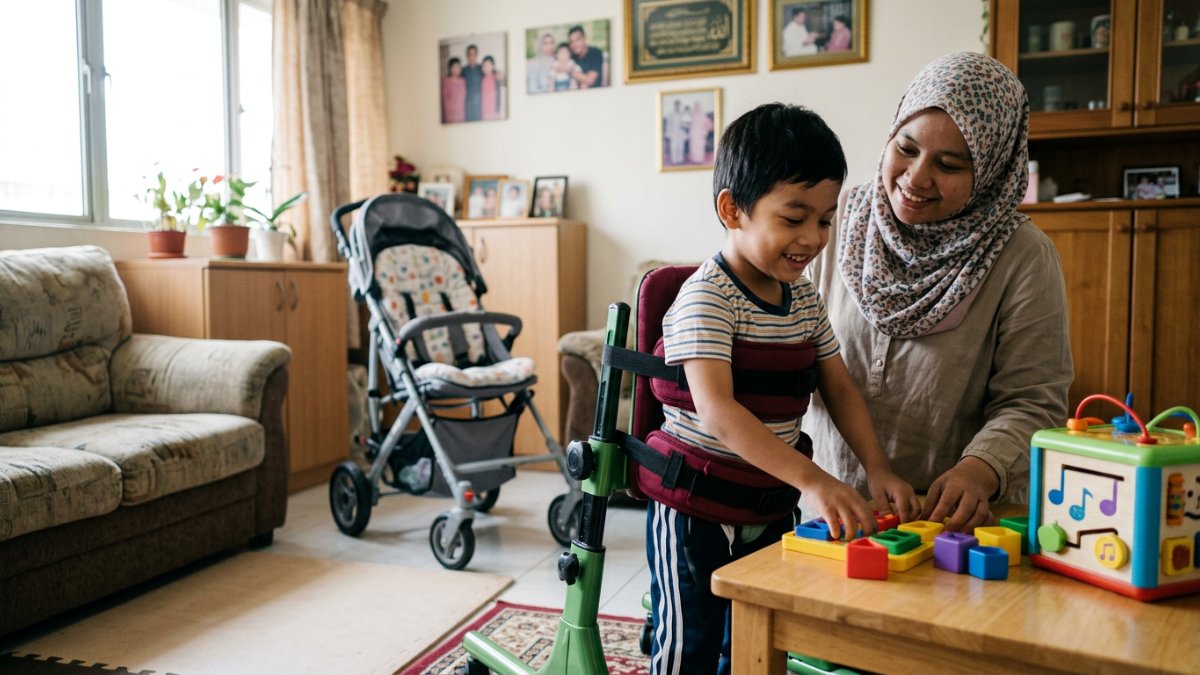
A standing frame holds a child upright for supported standing during therapy or play. A special needs stroller carries a child in a supported seat during outings. In our children’s product range, they do different jobs, so one does not replace the other. Many children use both at different times of the day.
At Neolee Rehab Supply, parents often ask which one to buy first. The honest answer is that they solve different problems. Our Children’s Product range includes standing frames, strollers and seating, so you can see how they fit together.
This guide explains what each one does and how they work side by side. Your child’s therapist should guide the final choice and setup.
What a standing frame does
A standing frame supports a child in an upright or partly upright position. Straps and pads hold the feet, knees, hips and chest in the right place. The child can then stand for a set time, even if they cannot stand alone.
Standing can help a child take weight through the legs. It also puts them at the same height as friends and family, which helps with play, school work and talking face to face.
The therapist decides the type of frame, the angle and how long the child stands each day. These depend on the child’s needs.
Our Joyride Child Prone Standing Frame holds the child in a forward-leaning position. It suits children between 90cm and 130cm tall. A standing frame is not made for travel or for sitting.
We explain the main frame types in more detail in our guide to prone, supine and sit-to-stand frames.
What a special needs stroller does
A special needs stroller is built for seated mobility. It lets a parent or carer move the child to school, appointments, shops and family outings.
Compared with an ordinary stroller, it gives more support to the head, trunk and hips. It often has adjustable seating and extra straps to keep the child well positioned.
Our Joyride CP Stroller has adjustable seating and reclining support. The seat can face forwards or backwards. Accessories such as a harness vest, raincover and sunshade can be added to suit the child and the weather.
If your child has outgrown an ordinary stroller, see our guide on when an ordinary stroller no longer gives enough support.
The goals are different
It helps to think about what each piece of equipment is for:
- Standing frame: supported standing, taking weight through the legs and joining in at standing height.
- Special needs stroller: getting from place to place, sitting well and resting during outings.
- Standing frame: used for set times in a therapy plan.
- Special needs stroller: used on routes, in shops, at school and in the car boot.
Both need correct measurements, careful adjustment and clear guidance for parents.
Why many children use both
A child might stand in a frame at home after breakfast, then ride in a stroller to school. After school, they might stand again during play or homework. Each piece of equipment covers a different part of the day.
Trying to make one do both jobs rarely works well. A stroller cannot give supported standing. A standing frame is not safe for moving a child along a road or in and out of a car.
If the budget is tight, ask the therapist which need is more urgent right now. Many families start with one and add the other later. Some also check whether assistance schemes can help with the cost. Our team can share product details if you need them for an application.
Planning children’s product equipment for home
Before any equipment arrives, think about where it will be used and stored. Both pieces take up space, and a busy home can fill up quickly.
A standing frame needs a clear, flat spot where your child can see what is going on. Many families place it in the living room or near a table, so the child can join in. Leave space around it for a parent to help with straps.
A stroller needs a place near the door and room in the car boot. Measure the boot opening before you buy. Check whether the stroller folds and how much it weighs when folded.
Plan the daily routine too. Decide who will help with standing time and who will handle outings. Equipment that fits easily into the day is much more likely to be used well.
Questions to ask the therapist
Bring these questions to your next session:
- Does my child need supported standing, and for how long each day?
- Which type of standing frame suits my child’s posture?
- What support does my child need in a stroller seat?
- Should the stroller seat face forwards or backwards?
- How often should we check the settings as my child grows?
Write down the measurements the therapist takes. Bring them when you visit or call our team, so we can match the right size.
A typical week with both pieces of equipment
Here is how one family in Penang plans the week for their six-year-old son:
- Weekday mornings: 20 minutes in the standing frame while he watches a short story.
- School days: the stroller takes him to the school gate and back.
- Afternoons: a second short stand during homework, if the therapist agrees.
- Weekends: the stroller for the market and visits to grandparents.
This is only an example. Your child’s own times should come from the therapist.
Review as your child grows
Children grow quickly, and their needs change. Check the frame and stroller settings every few months.
Look for straps that no longer sit in the right place, or pads that have reached the end of their adjustment. Watch for red marks on the skin after use, especially on the knees, hips and chest after standing time. Show the therapist any mark that does not fade soon after your child comes out of the frame.
Stop using the equipment and ask for advice if your child has pain, breathing trouble, unusual distress or a sudden change in posture.
Frequently Asked Questions
1. Can a special needs stroller replace a standing frame?
No. A stroller supports sitting and moving around. A standing frame supports a set standing position as part of therapy.
2. Can a standing frame be used for travel?
No. A standing frame is for supported standing in one place. Use a stroller or wheelchair to move your child.
3. Can one child need both?
Yes. Many children use a standing frame for therapy at home and a stroller for outings.
4. Who should recommend a standing frame?
A physiotherapist, occupational therapist or rehabilitation doctor should assess your child and guide the choice and setup.
5. How often should the equipment be checked?
Check the settings every few months and whenever your child grows, changes posture or seems uncomfortable.

